Comets
- Leonardo Oosthuizen
- 13 November 2025
Cosmic Messengers from the Edge of the Solar System
There’s something magical about seeing a comet streak across the night sky. Long before telescopes, humans gazed at these “hairy stars” with awe and wonder, often interpreting them as omens, messages, or celestial signs. Today, we understand comets as fascinating relics of the early solar system — icy time capsules that have traveled billions of kilometers to reach us.
What is a Comet?
A comet is made mostly of ice, dust, and rock. Think of it as a frozen ball of primordial material left over from the formation of the Sun and planets. When a comet approaches the Sun, it heats up, releasing gas and dust that form a glowing coma (the comet’s “head”) and often a spectacular tail that always points away from the Sun.
There are two main types of comets:
-
Short-period comets: These orbit the Sun in less than 200 years. Examples include Halley’s Comet, which visits Earth roughly every 76 years.
-
Long-period comets: These can take thousands or even millions of years to complete an orbit, often coming from the distant Oort Cloud at the edge of the solar system.
Why Are Comets Important?
Comets are more than just a beautiful sight. They are messengers from the early solar system, carrying clues about the materials that formed planets, moons, and even life itself. Scientists study comet dust and gases to learn about the origins of water and organic molecules on Earth.
How to See a Comet
Catching a glimpse of a comet can be a once-in-a-lifetime experience. Here are some tips for observing them:
-
Dark skies are key: Head away from city lights to see the tail clearly.
-
Check the comet’s path: Astronomy websites and apps track comets’ positions and brightness.
-
Use binoculars or a telescope: Even a small telescope can reveal details of the coma and tail.
-
Be patient: Comets often appear dim and require time for your eyes to adjust to the darkness.
-
-
Famous Comets
-
Halley’s Comet – The most famous of all, visible from Earth every 76 years.
-
Hale-Bopp – A spectacular comet that dazzled the world in 1997.
-
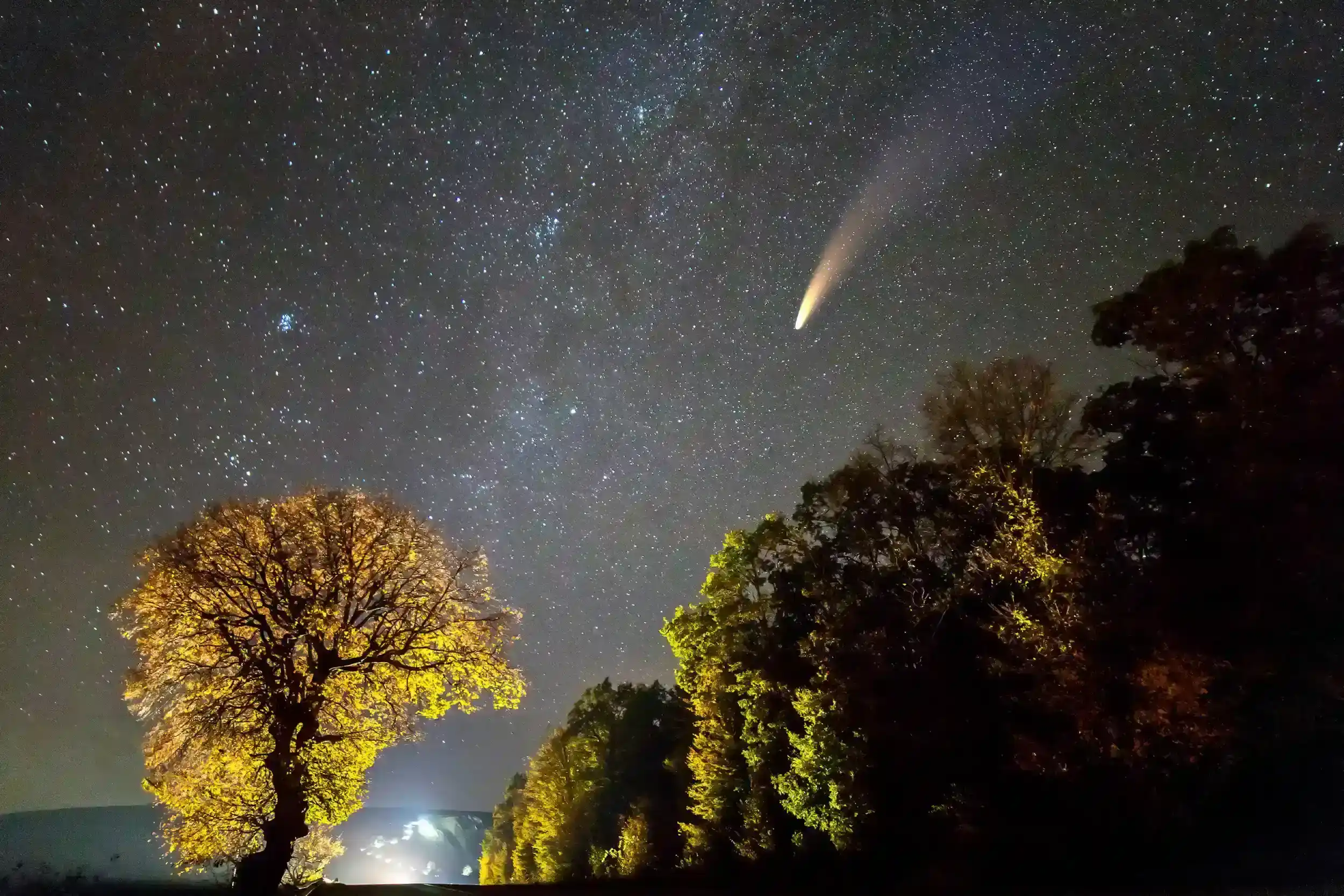
NEOWISE – Recently visible in 2020, with a stunning tail that thrilled stargazers worldwide.
-
-
Comets and Storytelling
Across cultures, comets have inspired myths, legends, and cautionary tales. From ancient Chinese astronomers recording “broom stars” to Indigenous stories across Africa and the Americas, comets were seen as messengers of change, connecting humanity to the wider cosmos.
At Night Sky Tours, we love sharing the wonder of comets, helping you see these icy travelers not just as celestial objects, but as storytellers from the far reaches of space. There’s something profoundly humbling — and exhilarating — about standing under the Karoo sky, knowing that what you’re seeing may have left its birthplace billions of years ago.
Elit scelerisque mauris pellentesque pulvinar pellentesque habitant morbi tristique.
✨ Next time you look up and see a streak of light, remember: a comet is more than a spectacle — it’s a messenger from the beginning of our solar system, carrying the story of the universe across time and space.

Leonardo Oosthuizen
Owner/Founder - Night Sky Tours
Join Us
INTERESTED ?
Let's Explore The UniversE
Lorem ipsum dolor sit amet, consectetur adipiscing elit, sed do eiusmod tempor incididunt ut labore et dolore magna aliqua.